
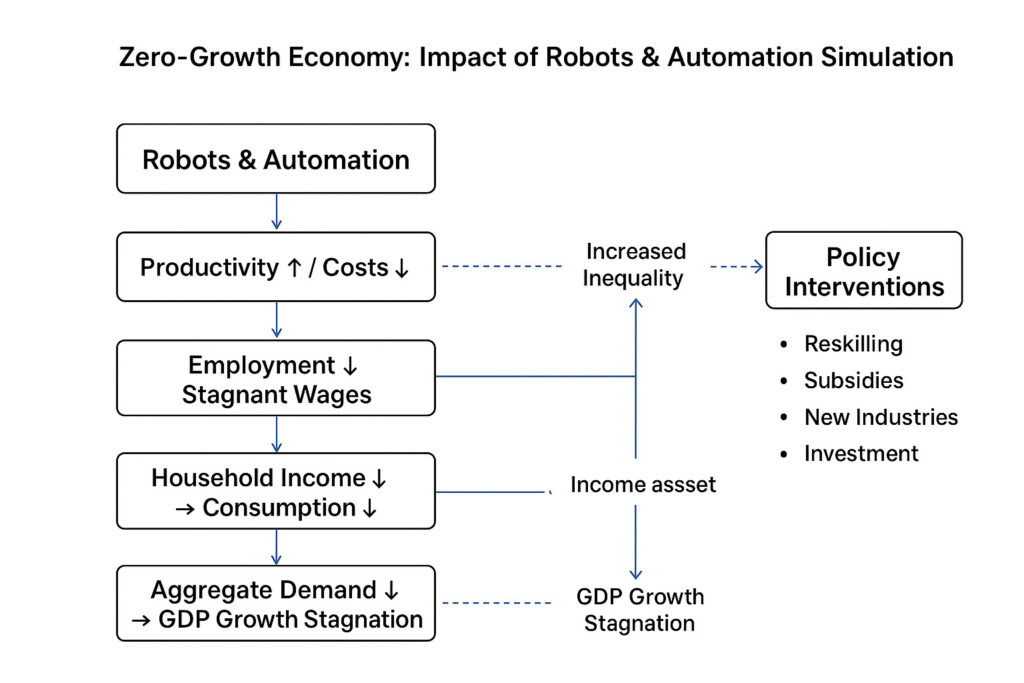
(1) Productivity Gains vs Growth Slowdown
- Robots and AI increase productivity.
- However, in a zero-growth environment, aggregate demand may be insufficient, so productivity gains do not necessarily translate into GDP growth.
- In other words, if production capacity expands but consumption and investment remain stagnant, overall economic growth may stay near 0%.
(2) Changes in Employment Structure
- Labor replacement by robots → stagnant real wages, reduced employment.
- In a low-growth environment, job losses lead to income stagnation → lower consumption → weaker demand → slower growth, creating a vicious cycle.
- Especially in a zero-growth economy, the employment shock from automation is more pronounced.
(3) Increasing Inequality
- Automation disproportionately benefits high-skill workers and capital owners.
- In a zero-growth economy, middle- and low-income households see limited income growth, worsening income and wealth inequality.
- Greater inequality → weaker consumption → persistent stagnation → reinforcement of zero economic growth.
(4) Cost Reduction vs Demand Stagnation
- For companies, robots enable cost savings and efficiency.
- However, in a zero-growth economy, reducing costs alone does not contribute to GDP growth if demand does not increase.
- Firms’ profits may remain stable or rise, but overall economic growth can remain stagnant.
Conclusion
- Automation and robots can boost productivity, but in a zero-growth environment, GDP growth is unlikely to increase.
- At the same time, employment losses and rising inequality can suppress aggregate demand, reinforcing zero growth.
- Therefore, effective strategies in a zero-growth context should combine automation with:
- Employment and reskilling programs
- Income support and consumption stimulation for low-income groups
- Creation of new markets and industries
- Policies to translate productivity gains from automation into overall economic growth